
The Wild Horse and Burro Population: Analyzing the 2025 to 2026 Changes
The Wild Horse and Burro Population: Analyzing the 2025 to 2026 Changes and the Ongoing Management Crisis
By Monica, Founder of Wild Horses Lives Matter
WE NEED TO PERSUE INDEPENDANT COUNTS OF WILD HORSES AND BURROS ON PUBLIC LANDS
The Bureau of Land Management (BLM) recently released its 2026 Wild Horse and Burro Population Estimates, revealing a significant increase in the number of wild equines roaming public lands. As an advocate dedicated to the humane treatment and protection of wild horses and burros, it is critical to examine these numbers, understand the trends, and address the ongoing management practices that continue to put these majestic animals at risk. This article provides a comprehensive analysis of the population changes from 2025 to 2026, breaking down the data state by state, and highlights the urgent need for a shift away from the ceaseless cycle of capture and removal.
The Appropriate Management Level (AML) Discrepancy
Overpopulation means more animals than allowed by the BLM’s plan, not necessarily more animals than the land can sustain.
The BLM establishes an Appropriate Management Level (AML) for each Herd Management Area (HMA), which represents the number of wild horses and burros that can thrive in balance with other public land resources and uses.
For both 2025 and 2026, the nationwide High End AML remained relatively static. In 2025, the combined High End AML was set at 25,556 (22,637 horses and 2,919 burros) . In 2026, it increased slightly to 25,592 (22,673 horses and 2,919 burros) .
The gap between the estimated population and the BLM's target AML continues to widen. In 2025, the BLM reported 47,574 "excess" wild horses and burros . By 2026, that number grew to 59,874
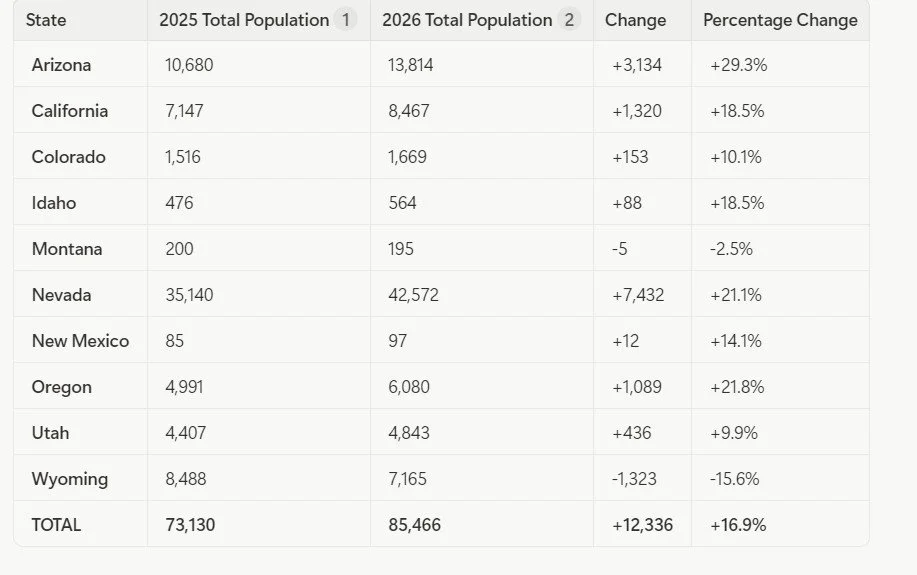
Key Observations by State
•Nevada: As the state with the largest wild horse and burro population, Nevada experienced a massive increase of 7,432 animals, bringing its total to 42,572 in 2026. This accounts for nearly half of the entire nationwide population. The High End AML for Nevada remained at 12,811 , meaning the state's population is now more than three times the BLM's target.
•Arizona: Arizona saw the highest percentage increase among states with significant populations, growing by 29.3% to 13,814 animals. The state's population is heavily skewed toward burros, with 13,546 burros estimated in 2026 .
•Wyoming: Wyoming was the only state with a large population to see a significant decrease, dropping from 8,488 in 2025 to 7,165 in 2026. This decrease of 15.6% brings the state closer to its High End AML of 2,566, though it still remains nearly three times over the target .
•Montana: Montana, which manages only the Pryor Mountain Wild Horse Range, saw a very slight decrease of 5 animals, bringing its population to 195, slightly above its High AML of 120
The Failure of the Capture and Removal Strategy
The data from 2025 to 2026 clearly demonstrates that the BLM's current strategy of relying heavily on helicopter roundups and removals is fundamentally flawed. When large numbers of horses are removed from the range, the remaining animals often experience compensatory reproduction—meaning they reproduce at higher rates due to decreased competition for resources.
Accountability and Transparency: We must demand accurate data, transparent management plans, and accountability for the welfare of animals during gathers and in holding facilities.
Protection of Habitat: Wild horses and burros are often scapegoated for range degradation, while privately owned livestock, which far outnumber wild equines, are given priority. We must advocate for equitable resource allocation and the protection of designated Herd Management Areas.
The 2026 population estimates are a wake-up call. The current system is broken, and the wild horses and burros are paying the price. It is time for a compassionate, science-based approach that keeps wild horses where they belong wild and free on our public lands.