The Math of Mismanagement: How Public Lands Policy Fails Wild Horses
Wild horses are an enduring symbol of the American West, yet their survival on public lands is increasingly threatened by policies that prioritize commercial livestock over protected wildlife. The Bureau of Land Management (BLM) is tasked with managing these herds under the Wild Free-Roaming Horses and Burros Act of 1971. However, a closer examination of the math behind the BLM's Appropriate Management Levels (AMLs) reveals a stark disparity in land and forage allocation, raising serious concerns about the genetic viability of wild horse populations .
The Livestock Allocation Disparity
While wild horses are held to strictly enforced AMLs, commercial livestock grazing on the same public lands receives a vastly disproportionate share of resources. The BLM authorizes grazing permits based on Animal Unit Months (AUMs), which represent the amount of forage required to sustain one cow and her calf (or five sheep) for one month .
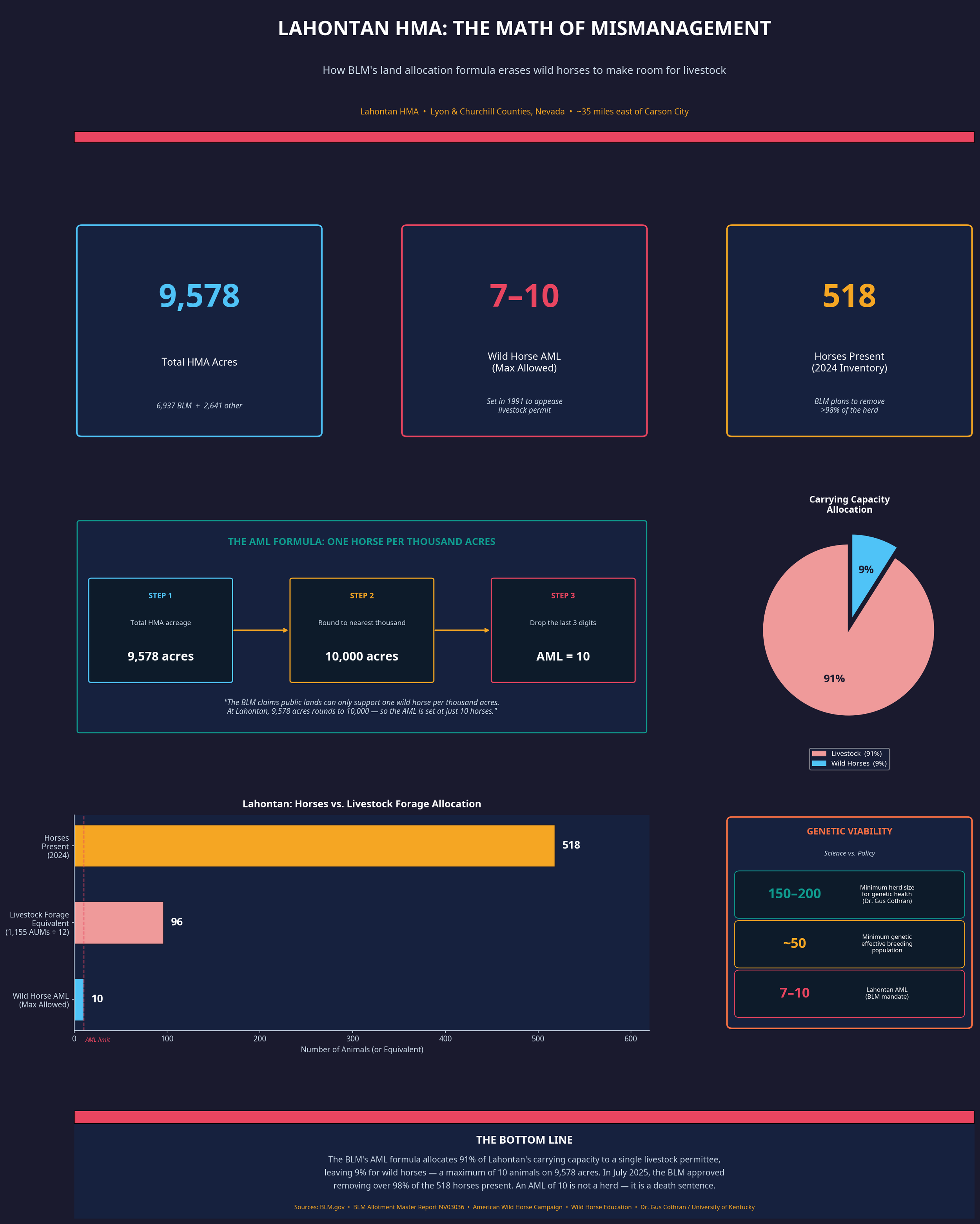
The disparity becomes glaringly obvious when we look at the Lahontan Grazing Allotment (NV03036), which overlaps the Lahontan HMA. According to the BLM's Allotment Master Report, the permittee (Snow Livestock LLC) is authorized for 1,155 active AUMs per year .
Since one AUM is roughly equivalent to the forage required for one horse, this livestock allocation is equivalent to sustaining 96 wild horses for a full year (1,155 AUMs ÷ 12 months = 96.25).
When comparing the two allocations on the same landscape, the inequity is clear:
•Livestock Allocation: Equivalent to 96 horses (91% of carrying capacity)
•Wild Horse Allocation: Maximum of 10 horses (9% of carrying capacity)
This means that the land is clearly capable of supporting significantly more wild horses. Instead, the BLM recently approved a gather plan to remove hundreds of horses from the Lahontan area to reach that absurdly low AML of 10 . The horses are consigned to off-range holding facilities to ensure the forage remains available for permitted livestock grazing.
The Threat to Genetic Viability
Perhaps the most critical flaw in the BLM's management strategy is its impact on the genetic health of wild horse herds. Genetic viability correlates directly with breeding population size, not with arbitrarily assigned AMLs.
According to leading equine geneticists, such as Dr. Gus Cothran, a minimum herd size of 150 to 200 animals is required to maintain long-term genetic diversity and prevent inbreeding . Within a herd of 150, only about 50 animals constitute the "genetic effective population"—the breeding-age adults actively contributing to the next generation.
When the BLM enforces an AML of 7 to 10 horses at Lahontan, they are mandating a population size that is biologically unsustainable. A herd of 10 horses cannot possibly maintain genetic diversity. Managing herds at these dangerously low levels leaves them vulnerable to disease, environmental changes, and eventual extinction. By prioritizing livestock AUMs over minimum viable population sizes, the BLM is actively managing herds like Lahontan to the brink of genetic collapse.
The current management of wild horses on public lands is driven by a mathematical formula that inherently favors commercial livestock over protected wildlife. As demonstrated by the Lahontan HMA, enforcing a "one horse per thousand acres" rule results in an AML of just 10 horses, while the overlapping livestock allotment is granted the forage equivalent of nearly 100 horses.