
The Bureau of Land Management (BLM) Jarbidge Field Office in Idaho has initiated a public comment period for a Determination of NEPA Adequacy (DNA) worksheet regarding the planned 2026 wild horse gather at the Saylor Creek Herd Management Area (HMA). The proposed roundup is scheduled to begin on July 10, 2026, with the goal of removing 105 wild horses and treating returned mares with the immunocontraceptive GonaCon-Equine.
Saylor Creek HMA Background and Population Dynamics
The Saylor Creek HMA is located approximately 15 miles south of Glenns Ferry in Owyhee and Elmore counties, Idaho. The area encompasses 101,876 acres of public lands managed by the BLM . The herd is known for its diverse colors, including pintos, sorrels, roans, palominos, bays, browns, blacks, and grays, generally standing 14-16 hands tall.
The BLM has established the AML for the Saylor Creek HMA at 50 wild horses . According to the BLM's official 2026 Wild Horse and Burro Population Estimates, the estimated population for Saylor Creek as of March 1, 2026, is 131 horses . The DNA worksheet currently under public review cites a current population of 129 horses .
This population level places the herd at approximately 262% of its established high-end AML. The BLM uses this discrepancy as the primary justification for the proposed gather, stating that the purpose is to "Achieve AML" . The FY2026 Tentative Gather Schedule indicates plans to gather 150 animals, remove 105, and treat 22 with fertility control.
The Saylor Creek Forage Imbalance
The Saylor Creek HMA is not exclusively dedicated to wild horses; it intersects with eight permitted livestock grazing allotments . An analysis of the forage allocation within the HMA reveals a significant disparity:
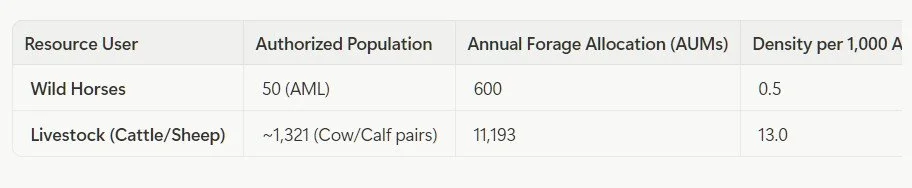
Note: One Animal Unit Month (AUM) is the amount of forage needed to sustain one cow and her calf, one horse, or five sheep for a month. Data based on 2019 Environmental Assessment analysis
The DNA worksheet currently out for public comment notes the current horse population and the AML but conspicuously omits the amount of forage assigned to livestock
This omission prevents the public from easily determining if the land is truly overpopulated or if the forage is simply disproportionately allocated to commercial interests. The data indicates that the total forage allowed by the plan for livestock inside the HMA is nearly 19 times greater than the forage allocated for wild horses
The current public comment period centers on a "Determination of NEPA Adequacy" (DNA) worksheet (Project Number: DOI-BLM-ID-T010-2026-0005-DNA)
****PUBLIC COMMENT***
The public comment period runs until May 15, 2026
. For advocates, commenting on a DNA requires a specific strategy. Because the BLM is claiming that old documents are sufficient, effective comments must demonstrate why new circumstances or new information require a fresh Environmental Assessment.
Key points to raise in public comments include:
1.
Demand Forage Allocation Transparency: Challenge the DNA's failure to disclose livestock AUMs. Argue that "Appropriate Management Level" cannot be accurately assessed without a transparent, data-driven analysis of how forage is allocated between horses and commercial livestock.
2.
Challenge the Use of GonaCon-Equine: Cite the 2017 Saylor Creek court ruling, which mandated that the BLM must analyze the behavioral impacts of sterilization. Argue that GonaCon's suppression of estrus constitutes a behavioral alteration that has not been adequately analyzed in the older NEPA documents the DNA relies upon.
3.
Highlight Changed Circumstances: Point out any changes in range conditions, climate, or herd dynamics since the original NEPA documents were drafted, arguing that a DNA is insufficient and a full, new EA is legally required.
4.
Oppose "Gather Plans" as Management Plans: Note recent court rulings establishing that long-term gather plans do not substitute for foundational Herd Management Area Plans (HMAPs), and demand that the BLM complete a comprehensive HMAP before initiating further removals.
Conclusion
The proposed 2026 roundup at the Saylor Creek HMA highlights systemic issues within the BLM's Wild Horse and Burro Program. The reliance on a DNA worksheet bypasses current environmental analysis, while the stark disparity in forage allocation suggests that the "overpopulation" crisis is largely a product of prioritizing commercial livestock. Furthermore, the planned use of GonaCon-Equine raises serious animal welfare and legal concerns regarding the preservation of natural herd behaviors. Advocates must use the current comment period to demand transparency, equitable resource allocation, and adherence to the protective mandates of the 1971 Act.